The group has a turnover of €40 million and employs 425 people in Spain, Morocco and Latin America.
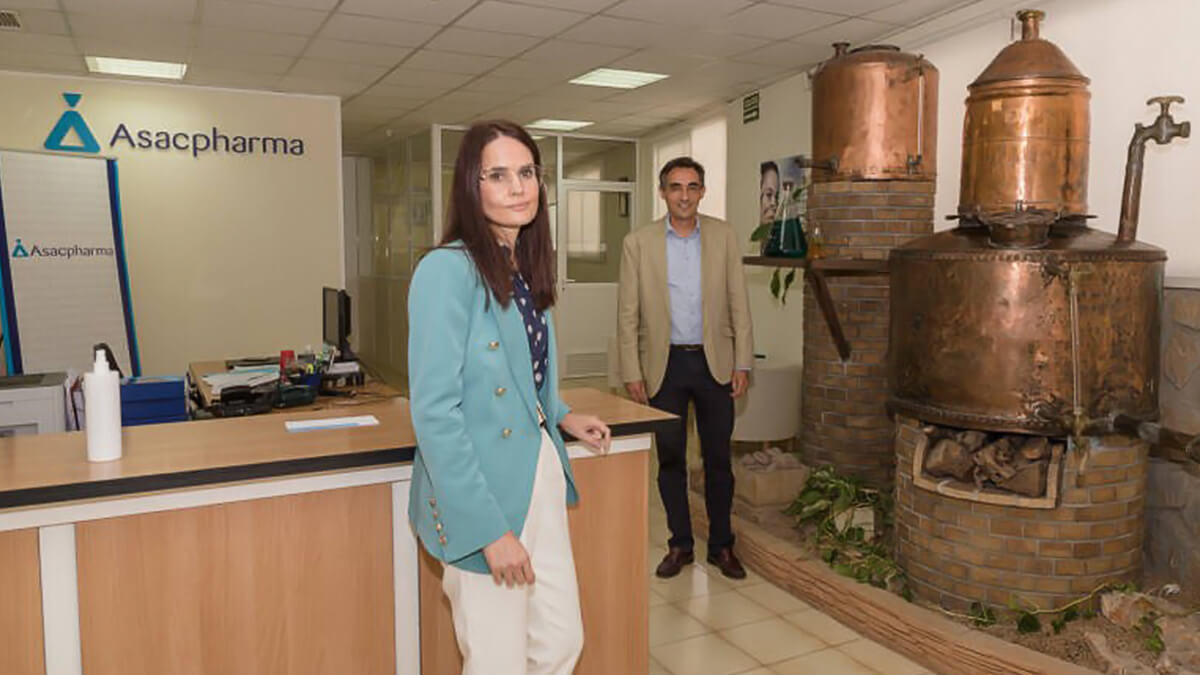
At the start of Carretera Ocaña road, on the way out of Alicante towards Madrid, turn right at the first crossroads to take Calle Sagitario street. Towards the end of the street, just before you run out of tarmac, you will find a brick building, which doesn’t give any indication of what goes on inside. This is the Asacpharma headquarters. Although unknown to the general public (unlike some of its brands), the Group is one of the most important pharmaceutical companies in the Valencian Community.
Asacpharma employs 425 people around the world and has an annual turnover of €40 million, more than half of which comes from sales abroad. With two production plants in Alicante and one in Murcia (both in Spain), plus one in Morocco (the largest) and another in Brazil, Asacpharma exports its medicines to dozens of countries, where it is a reference in three medical lines: musculoskeletal, dermatological and respiratory.
This last line, owned by Asac Pharmaceutical Immunology (API), is the one that most distinguishes the Group led by Eliseo Aller (who accompanied us on the visit), although its shareholders include three families from Alicante and a Moroccan partner. It might only account for a small proportion of the Group’s turnover (about €5 million each year, although the aim is to double this figure in three years), but API does what no one else in the Valencian Community can do: it is the only laboratory authorised to produce biological medicines for human use.
Essentially, API produces personalised allergy treatments, based on tests carried out on each patient by allergy specialists. However, it is also dedicated to creating autovaccines, or as they call them, “vaccines with names and surnames”. A literal statement, since each biological vaccine is created for a single patient according to the infection being treated, and leaves the laboratory with their name and surname on a label next to the barcode, heading for the pharmacy where they will collect it.
The Group is firmly committed to producing sublingual allergy treatments and autovaccines against all types of microorganisms. Between 2017 and 2019, the Alicante pharmaceutical company invested almost €4 million in the new API facilities, over €3 million of which in machinery and apparatus. It also bought the adjacent warehouse in anticipation of future growth. However, a process like this is far from simple, as it has to be validated by the Spanish Medicines Agency.
“We knocked down the entire plant inside and spent six months on the building works, and another year and a half working to pass the validation process, as we had to undergo a thorough review,” explains Aller. Flavia Hernández, Asacpharma Technical Director from Crevillent, Spain, explains that the laboratory sent bulk materials to its plant in Brazil during this period, so that it could continue working while the Alicante site was at a standstill. “We are leaders in allergy treatments in Brazil and Mexico”.
In 2020, its first full year after the plant expansion, API had a turnover of €5 million and ended the year with 40 highly qualified employees. “Our forecast is to double our turnover in the next three years,” predicts Aller, “and for EBITDA to reach 15% of our turnover”. 55% of the Group’s turnover comes from abroad (as well as biological medicines, Asacpharma works in the musculoskeletal and dermocosmetics fields, with brands such as Sensedol and Atache). In addition to its Moroccan and Brazilian subsidiaries, the pharmaceutical company also exports to Greece, Macedonia, Albania and Ukraine, and is developing markets in Italy and Portugal. It also has agreements with local distributors in Korea, Australia, Turkey and Belarus. API’s target market is not the pharmaceutical cooperatives, or even patients, but the specialist doctors who prescribe allergy treatments or autovaccines. “The doctor does the test, we receive the results report, and we manufacture a personalised treatment for the patient’s specific allergy within 11 to 14 days,” explains Hernández. All vaccines are sublingual, as they are “easier to administer,” and the process is fully monitored and temperature-controlled until the vaccine reaches the pharmacy, where it is collected.
The procedure is the same for biological autovaccines, but with a longer waiting time. “We collect the patient sample, identify the bacteria present in a culture, and a specific treatment is prepared based on the exudate,” says the laboratory’s Technical Director. “Since we have to isolate the colony, it takes a little longer to develop the product”. These autovaccines are administered to combat repetitive infection cycles, the recurrence, and include E.coli among the most common bacteria.
Both processes are carried out in modern facilities, where everything from the air to the number of people in the same room is controlled, with secured doors and different protocols (and protections) for each area. All the work is done in pairs, who double check each other to avoid errors, as these are personalised treatments, and the final product usually spends hardly any time in the warehouse, as it is produced on demand. Once finished and labelled, the medicine leaves API with the patient’s name and surname.